Julia Muller
Turbulent Flow Research
Julia Muller, Ph.D.
Ph.D. Advisor: Dr. Joseph Oefelein
ABOUT JULIA'S RESEARCHHi! Welcome to my website documenting my research efforts.
In Fall 2025, I graduated from the High Performance Computing Laboratory with my Ph.D. in aerospace engineering. My advisor was Dr. Joseph Oefelein. My research focused on two major topics: 1. Deriving efficient, reliable, and straightforward loosely coupled methods for conjugate heat transfer applied to wall-modeled large-eddy simulations and 2. Understanding the unsteadiness mechanisms for non-adiabatic shock boundary layer interactions.
Select Publications and Research Works
Analysis of Shock-Wave/Boundary-Layer Interaction Unsteadiness Mechanisms Using Conjugate Heat Transfer and Wall-Modeled LES
Julia Muller, Chelsea Johnson, Meghna Dutta, and Joseph Oefelein
AIAA 2025-1892
Session: Shock Wave Boundary Layer Interaction: LES
doi: https://doi.org/10.2514/6.2025-1892
Abstract: Loosely coupled conjugate heat transfer (CHT) and wall-modeled large eddy simulation (WMLES) are used to analyze the unsteadiness mechanisms driving the characteristic motion of a separation bubble induced by shock-wave/boundary-layer interactions (SBLI) for highly nonadiabatic flow. Three cases are analyzed, a “warm” case with a far wall temperature condition of T_fw/T_r = 1.5, a “baseline” case with T_fw/T_r = 1.05 that matches the reference experiment, and a “cold” case with T_fw/T_r = 0.5. It is shown that the baseline case reproduces the experimental results well. The sensitivity of the mean separation bubble characteristics to the wall thermal condition is found to be primarily driven by a balance between the upstream mean momentum in the boundary layer and pressure rise across the lambda shock. The cold case shows more organized coherent structures, including the presence of hairpin super-structures according to plots of Q-criterion. The power spectral density of the wall pressure power is compared between the cases. It is found that the warm case has the lowest characteristic frequency overall. Instantaneous pressure and momentum fluctuations are high- and low-pass filtered by the characteristic separation bubble frequency. Correlation coefficients derived from these quantities show that the low-pass filtered momentum and pressure are much more strongly correlated in the pre-bubble and separation onset locations compared to the high-pass filtered quantities. In those same locations, the high-pass filtered quantities are not correlated. Near the reattachment location, the correlation coefficients are nearly insensitive to filtering and show non-negligible correlation for the high-pass, low-pass, and unfiltered pressure and momentum. The average hairpin vortex is extracted for both the cold and the warm cases across three key regions of the SBLI domain and is compared. In the pre-bubble region, the warm case shows a smaller, shorter, and less inclined hairpin vortex than the cold case.
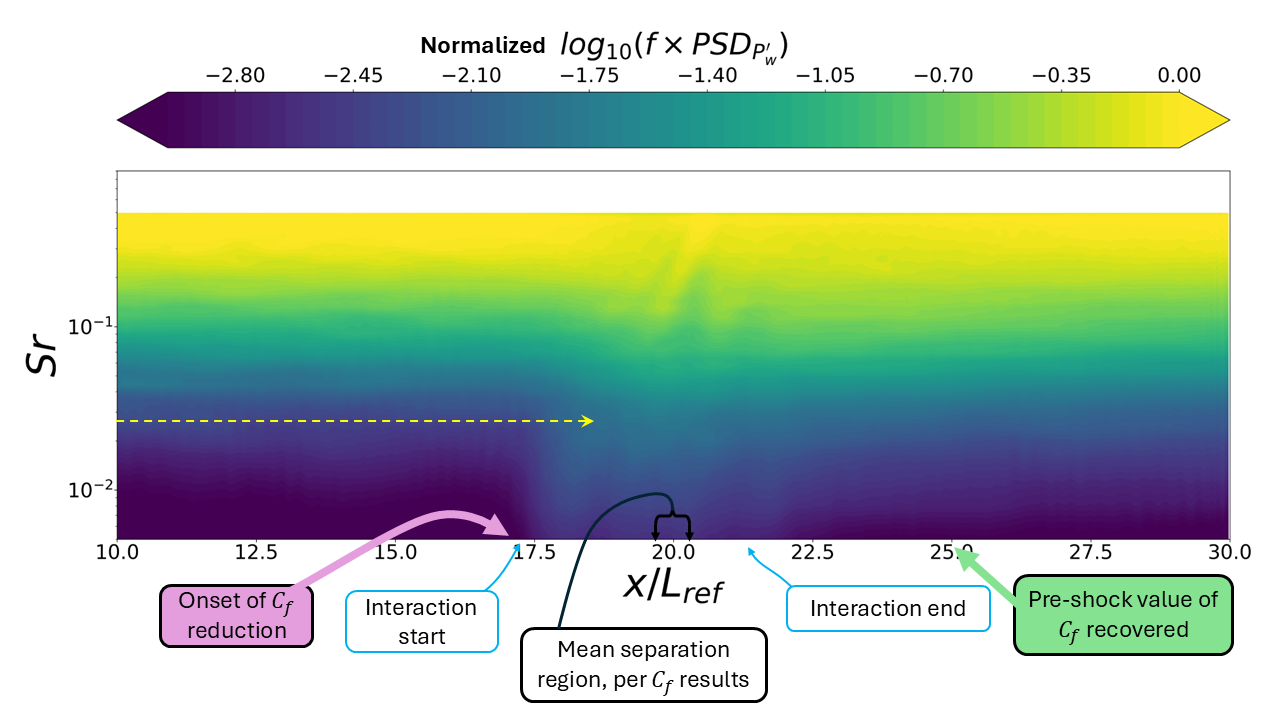
Cold case pre-multiplied power spectral density
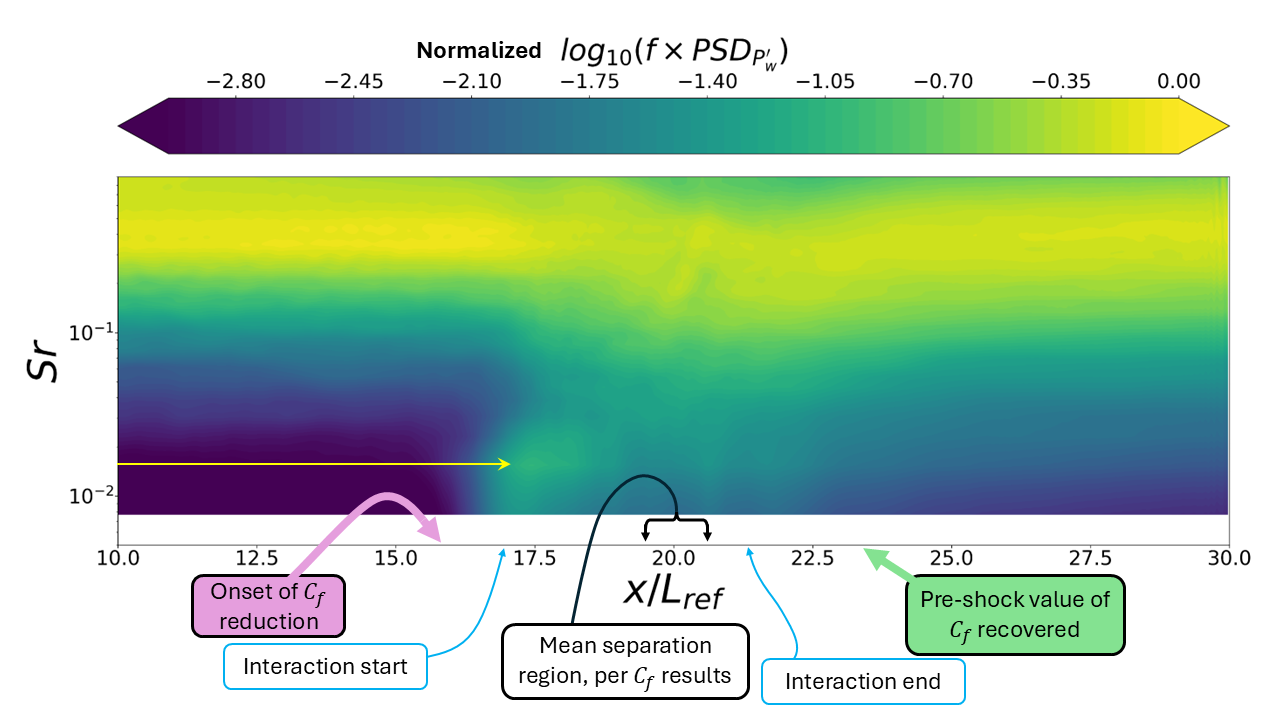
Baseline case pre-multiplied power spectral density
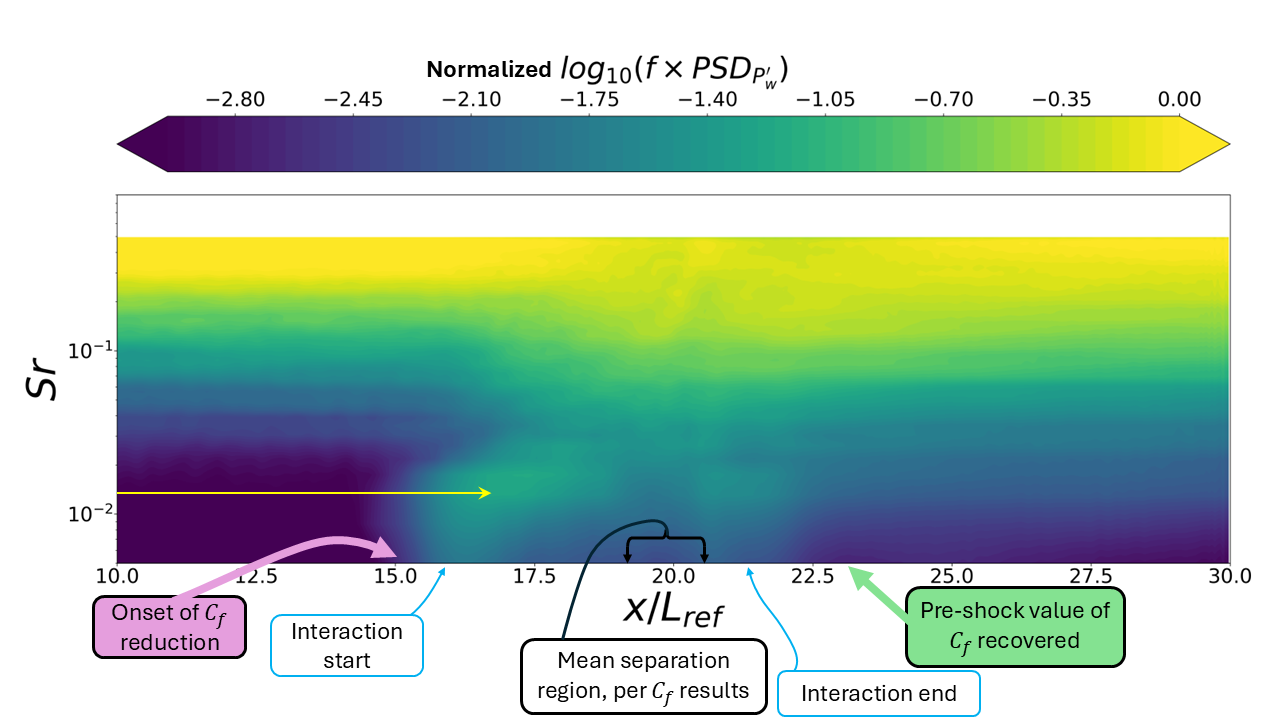
Warm case pre-multiplied power spectral density
NOTE: The images here are not the same as the analogous images in the conference paper, these are actually from my thesis. It’s the same data, however, and these images are a bit more cleaned up. The PSD images in particular are using Welch’s method with three segments of 50% overlap, in the conference paper, it’s a less elegant approach.
My Thesis.
Please send me any email at juliaamuller7@gmail.com for a copy of my thesis work. I am also happy to meet with you and discuss any questions you have about the research, methods, or conclusions.
The executive summary is copied below.
Intense thermal loading due to the nature of compressible aerodynamics, turbulent boundary layers, and combustion puts high-speed, high-enthalpy vehicles at risk for thermal fatigue and failure. Accurately predicting and controlling the interaction of heat transfer and compressible turbulent boundary layers is critical to optimal design of these vehicles. This interaction has been an active area of research for decades and is extremely challenging to study analytically, experimentally, and computationally.
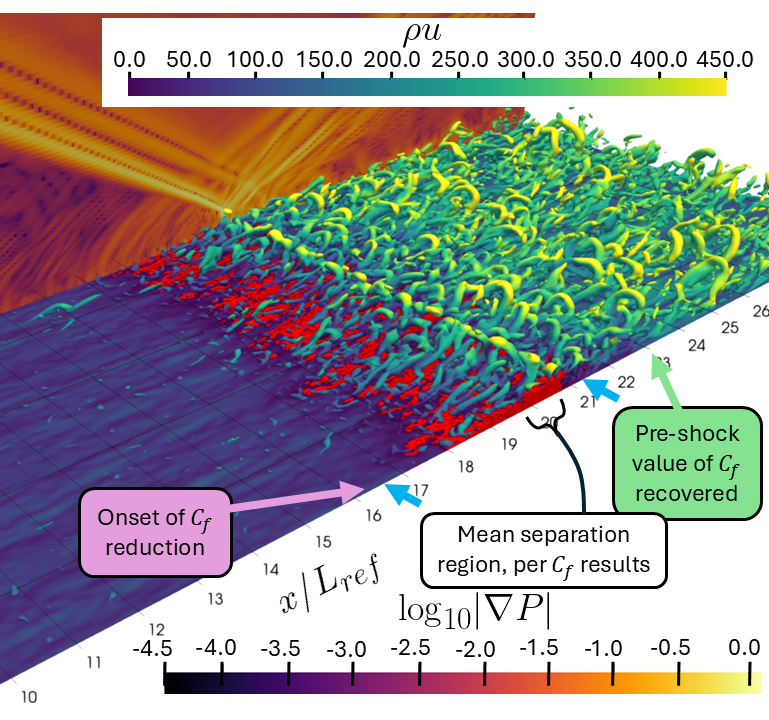
A prominent high-speed flow phenomenon is in the shockwave boundary layer interaction, or SBLI, in which a shock impinges on a boundary layer, leading to an unsteady local recirculation region known as the “separation bubble”. SBLI further complicates already challenging thermal and fatigue management due to inducing strong pressure oscillations and locally highly unsteady heat transfer oscillations. A primary objective in the study of SBLI lies in understanding the physical mechanisms driving the “breathing” motion of the separation bubble, which has been shown to oscillate at low frequencies in both shape, size, and position.
Mechanisms driving SBLI unsteadiness broadly fit into two categories. The first is the upstream mechanism, in which the unsteady fluctuations of the SBLI are thought to be driven by the large-scale coherent superstructures imparting low-frequency oscillations onto the separation bubble. The second is the downstream, or global, mechanism, where downstream sources of unsteadiness are linked to the SBLI, or broadly covers any mechanism which views the unsteady motion of the SBLI as intrinsic to the instability of the separation itself. Note that the “global” terminology is merely a nomenclature used in the literature, here, the SBLI appears to be a convectively unstable. This classification is reinforced by the results of the reduced-order model derivation, which is elaborated upon below. Large-scale SBLI tend to be primarily influenced by the downstream mechanism, whereas small or weakly separated flows generally favor the upstream mechanism. While xxi heat transfer demonstrably affects the hypothesized mechanisms driving the breathing motion of the separation bubble, their link has not been thoroughly explored in the literature.
Numerical simulations of these elusive flow physics is an attractive alternative to direct mathematical analysis and experimentation, due to its potential flexibility and the ability to sample the entire flow field for data. It is typical for Computational Fluid Dynamics (CFD) simulations of all classes, i.e., Direct Numerical Simulation (DNS), Large Eddy Simulation (LES), and Reynolds Averaged Navier-Stokes (RANS) simulations to implement Dirichlet or Neumann-type boundary conditions in most flow analysis problems. While these boundary conditions are simple and computationally cheap, they neglect physical complexities that involve dynamically coupled heat transfer between the solid body and the fluid flow. A higher fidelity heat transfer boundary condition is the Conjugate Heat Transfer (CHT) condition, in which thermal energy transport within the solid domain is simulated and coupled to the fluid domain.
Although CHT represents a more physically accurate boundary condition, it has not seen wide application in DNS or LES, and for most practical engineering purposes has been limited to RANS simulations. This is because of the extreme cost CHT introduces due to the addition of time scales in the solid domain, which are typically orders of magnitude larger than the fluid time scales. The disparity between these scales significantly extends required run times of fully-coupled simulations making them prohibitively expensive.
A variety of loosely coupled methods have been proposed in the literature to mitigate the cost of CHT. A summary of past work is provided in Chapter 1. Loosely coupled methods for CHT+LES have been adopted in the study of turbine blades, rocket cooling systems, and burner-injector systems with good success. However, they rely on assumptions whose implications on the results have not been thoroughly explored and quantified. Prominent methods rely on arbitrary user input and a posteriori, problem specific validation. Long term fluid averages, implicitly enforced through arbitrary user input, may be intuitively what the solid domain responds to, but the trade off between longer fluid aver xxii ages and accuracy of the results has not been fully characterized. Additionally, improper solid domain grid resolution may result in poor prediction of solid-fluid interface heat flux due to poor resolution of the thermal fluctuations in the solid domain.
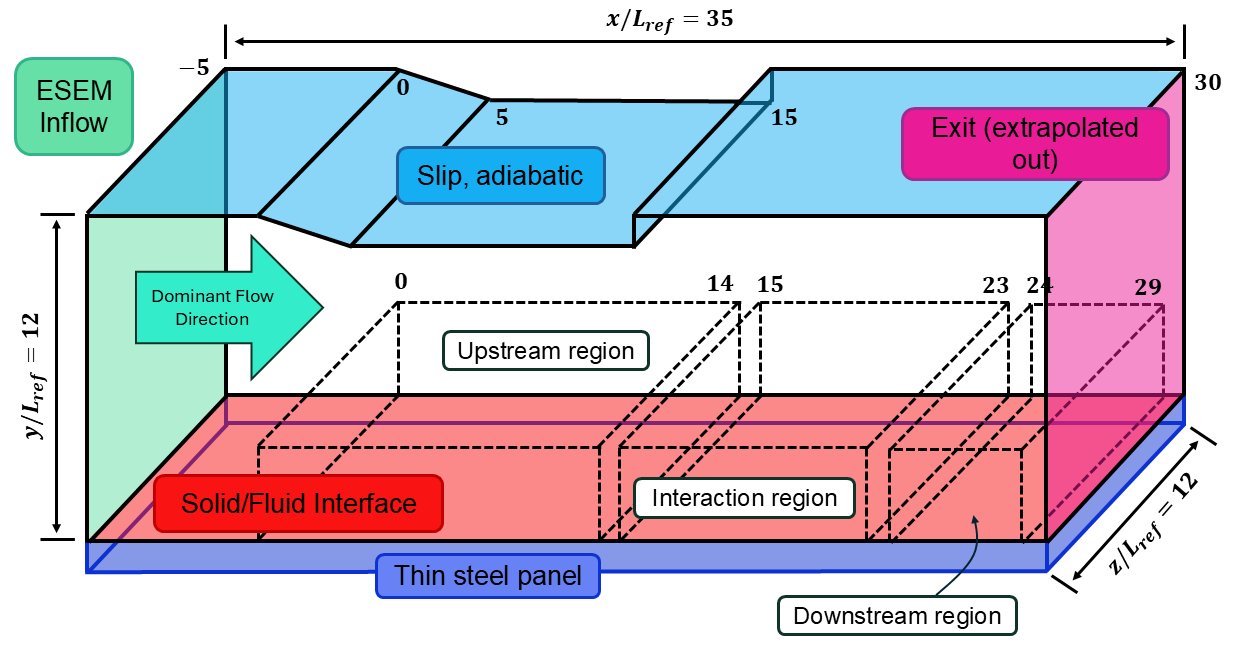
In this work, a novel loosely-coupled CHT methodology, dubbed the “Hacked Material Method,” (HMM) is developed and integrated into a wall-modeling LES (WMLES) approach. This novel methodology is then validated through a series of canonicalized supersonic boundary layer simulations. These simulations, in addition to validating the HMM and WMLES, also explored the cost-error tradeoff of neglecting solid domain fluctuations, analyzed the consequences of a poorly resolved thermal penetration depth, and validated strategies to mitigate errors that the novel methodology introduces. Ultimately, it was found that the solid domain fluctuations, well-resolved or poorly resolved, are unlikely to be con sequential for realistic solid materials and typical supersonic boundary layer flows. The HMM is shown to be straightforward to implement, have easily mitigated errors, and result in orders of magnitude of numerical cost reduction over fully coupled CHT. It also found to result in mean field convergence times that are faster than an existing, widely-used method ology. Recommendations to future users of the HMM, and LC-CHT + WMLES in general, are made in Chapter 7.
As a final validation step, the HMM and WMLESmethodologyisappliedtoaMach2.5 thin steel panel SBLI. The primary performance metric was in the separation length, which was found to have excellent agreement to the experiment for the CHT case. The adiabatic case, simulated as a comparison point to the HMM and WMLES, was found to under-predict the separation length. Other performance metrics included mean wall pressure curves, wall pressure RMS, and broad solid-fluid interface temperature variation. All metrics showed decent agreement for the HMM + WMLES, with improvements over the adiabatic case.
The baseline HMM + WMLES SBLI is then extended into a warm-wall and cold-wall case. The unsteadiness mechanisms of the SBLI are compared across these three wall temperature conditions. The non-adiabatic SBLI are validated against DNS of non-adiabatic xxiii SBLI, and are found to show decent agreement. Broad characteristics of the SBLI across the different thermal conditions are compared. Fluctuations throughout the domain are low- and high-pass filtered to separate the effects of low-frequency unsteadiness and potential sources of excitation, through, e.g., coherent superstructures from the high-frequency portion of the turbulence. Correlation coefficients show that the incoming momentum fluctuations correlate strongly to the separation length fluctuations. The strongest correlations across the board appear over the low-frequency fluctuation components and are strongest in the warm-wall case(s). Warm wall pressure PSD also shows evidence for the warm(er) wall cases having increased dynamic activity relative to the comparatively more stable cold case.
Through a modification of an existing low-order model of the SBLI, which views the SBLI system as a low-pass filter, further insight into the non-adiabatic SBLI dynamics is obtained. This modification stems from the strong influence of quasi-freestream flow field gradients which were neglected in the original model derivation. These outer boundary layer gradients are strongest in the cold wall case, which is attributed to the smaller, more compacted size of the cold wall SBLI. It is found that the primary influence of the nonadiabatic wall is on the mean characteristics and structure of the SBLI, which in turn affect the SBLI’s reactivity to forcing. The modification of the non-adiabatic wall on the dynamic system’s forcing, through, e.g., modification of the coherent superstructures is found to be a less important, though certainly a non-negligible effect.
Altogether, this dissertation contributes in two major ways to the research community. First, in its derivation and validation of a novel loosely coupled CHT method for LES and DNS of statistically stationary flows. The HMM is straightforward to implement and was shown to provide statistically similar, if not identical, flow fields for orders of magnitude less computational cost. Second, the dissertation work applies the HMM + WMLES methodology to study the unsteadiness mechanisms of the SBLI. Ultimately, the fluctuations of the solid wall were found to be of minimal consequence to the behavior of the xxiv turbulent flow and separation bubble, with the mean temperature variation a far more significant influence. The mean wall temperature broadly affected the structure of the SBLI, e.g., changing the interaction and separation length which in turn alters the peak frequency of the SBLI. While it was found that the forcing of the system was indeed affected by the non-adiabatic wall, the overall structure of the SBLI was a far more dominant effect on the SBLI dynamics. Future investigations should clarify the dynamics between the interaction region of the SBLI (e.g., the compression wave structure and its movements) and the separation bubble itself, and how the non-adiabatic wall affects these dynamics.